Wednesday, 29 August 2018

Deulti- Abode of Sarat Chandra Chattopadhyay


“Shongshare jara sudhu dile, kintu pele na kichui jara durbol, utpirito, manush hoye o manush jader chokher joler kokhon o hishab nilen na, nirupay dukkho moy jibon e jara konodin bhebei pelen na. Shomostho thekei o keno tader kichu tei odhikar nei, tader bedonai dilo. Amar mukh khule tarai pathalo manusher kache manusher nalish janate. “

― Sharat Chandra Chattopadhyay

River Rupnarayan


With this quote written on the left side of the gate still stands proud the beautiful house of the great Bengali novelist Sarat Chandra Chattopadhyay known as Sarat Chandra Kuthi. Sarat Kuthi is located in Samta in Deulti, Howrah about 50 km drive from Kolkata. Deulti is a small village located towards the west part of Bagnan. One can visit the land of Sarat Chandra in one day. It takes only one and a half hour to reach from Kolkata. The bank of River Rupnarayan is a famous picnic spot.

About the Author 


Sarat Chandra Chattopadhyay was born on 15th September, 1876 in Debanandapur, Hoogly. He started his career as an Author with the story ‘Mandir’. He received the Kuntolin award for his first masterpiece- Mandir.  He also gained popularity with his pseudonym Anila Devi, the real name of his elder sister. He Sarat Chandra Chattopadhyay’s first wife was Shanti Devi who died in Burma due to Plague. His boy child from the first wife also died from the same sickness. 
After the death of his first wife, he got married to Hironmoyee Devi who was previously known as 
Mokkhoda. He was also a homeopath and was therefore known as Dr. Sarat Chandra Chattopadhyay. The author composed popular novels like Palli Samajh, Parineeti, Mahesh, Shubodha, Srikanto, Devdas etc. Sarat Chandra died on 16th January, 1938 at the age of 61.


About the house

Sarat Smriti Mandir is written in Bengali on the right side of the gate and followed by this there is a quote from the popular novel Mahesh written below. The house is two storied and has been built in Burmese-style. Sarat Kuthi was built on the bank of River Rupnarayan, which still flows by but the river has moved far away in the due course of time due to excessive silting. It is said that the author has penned down some of his famous novels and stories in the study of this house. It is known that the author spent the last twelve years of his life in this house. The study and other rooms along with its furniture are still preserved with great care for more than a century now. This house was once the home of Sarat Chandra’s brother Swami Vivekananda also. There are many things of interest still preserved in the house which, according to the sources, draws the tourist from abroad. The building is now a museum containing various articles used by the author in his daily life. Let’s together explore the abode of the great Bengali Novelist.


The Garden

As one enters the compound of Sarat Chandra Kuthi, one can see the huge house standing in front
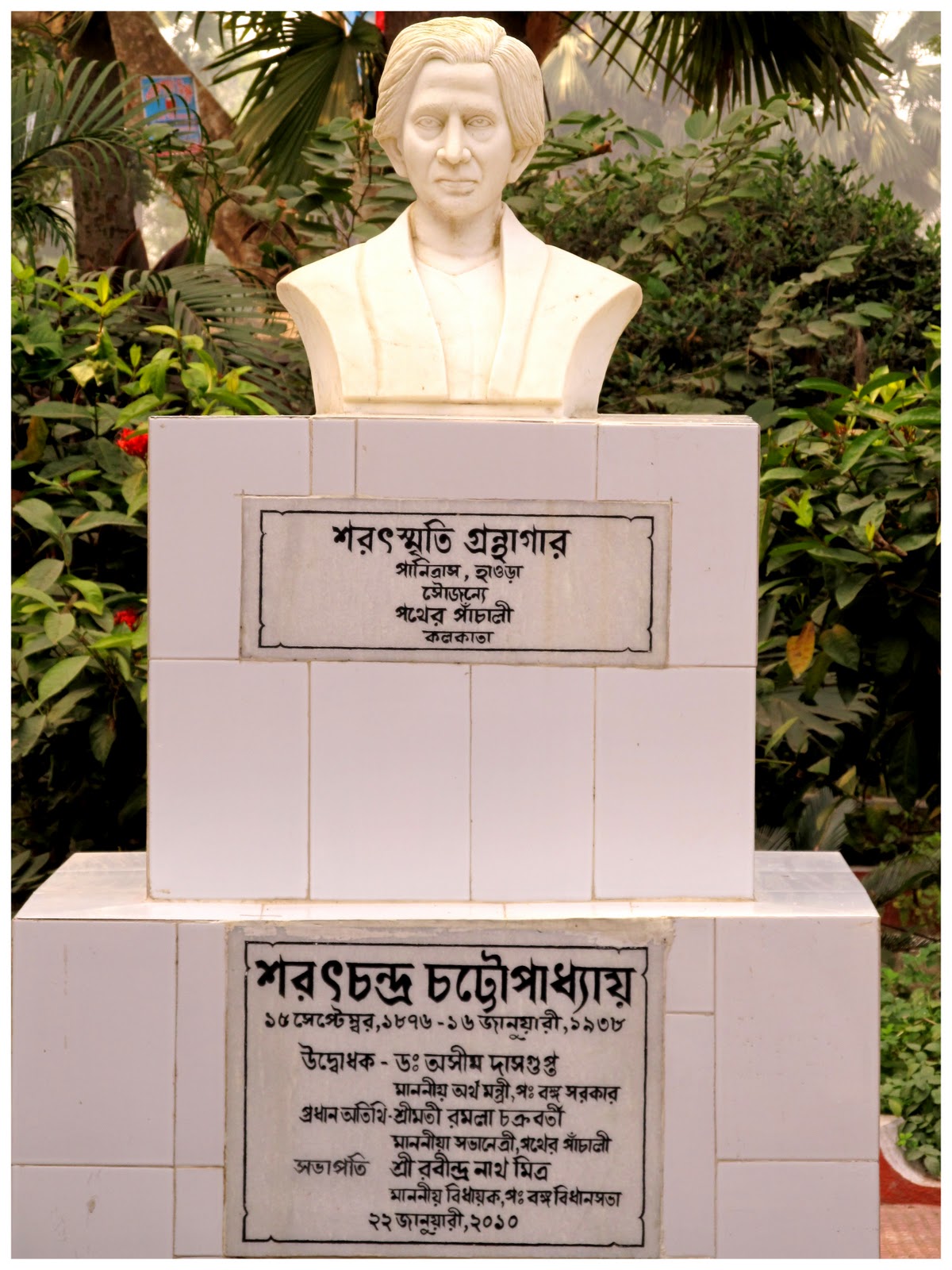
among the beautiful garden. Towards the left of the garden a statue of the author stands. One can also spot the Guava tree mention in the novel Palli Samajh. The samadhis of Sarat Chandra
Chattopadhyay, his wife Hironmoyee Devi and brother Bedananda lie in the end of the garden. The puja mandap is also in the same garden.


The Bust
The marble bust of the author is situated at the left side of the garden, among some beautiful plantations. The statue was erected by Dr. Ashim Dasgupta, former Finance Minister of West Bengal in 2010.


The Guava Tree

The author during his stay in this compound planted various trees in the garden. Among them were some bamboo trees and Galoncho with guava trees. One guava tree has grown up exactly in front of the main house. According to the sources, it is said that this tree is more than 90 years old. The same tree is said to be mentioned in the author’s masterpiece Ramer Sumati. The trees are still an attraction to the tourists.


The Samadhis

In the memorial of the great novelist, Sarat Chandra and his beloved wife and brother three stones have been laid in the compound of the Sarat Chandra Kuthi. Initially, the three samadhis used to be on the road outside the compound. Later it was brought under the same compound by extending the boundary walls of the garden.

Samadhi of Sarat Chandra's second wife Hironmoyee (left); The samadhi of brother Debananda (left) & Sarat Chandra Bose (right)


The Ground Floor


The ground floor has a front veranda with three rooms. The first one is the study of Sarat Chandra. Beside it is a bedroom and then is the homeopathy chamber. After the chamber, there is a small corridor leading to the stairwell of the first floor. On the front right-side of the house, there is a huge cage. It is said that the author loved animals so he kept peacocks. The kitchen and dining hall is also down but is under construction.


The Study Room

1- Bookshelf; 2- Arm chair; 3- Chappal worn by Sarat Chandra, 4- Study table
The study room is quite small. It has a writing desk, an arm chair and a bookshelf. Some shelves are made on the walls. They still have some books and old pictures. In the same room one can see Sarat Chandra’s walking stick & chappals preserved in a box. The arm chair has his framed photo and a picture of his dead body adorned with flowers and garlands. The guide will narrate to you stories of the past. According to him, Sarat Chandra used the room as the study because the huge window used to give him the view of the river. The river was very near to the house that time. The author composed great stories like Abhagir Swargo, Bamuner Meye, Mahesh, Ramer Shumoti, Palli Shomaj, Srikanta fourth part and last he wrote Bipradas in this room.

The Bedroom

Just next to the study room is a bedroom. It is quite spacious. The bed is kept on the left side of the room. A white bedcover is laid white two pillows. There is a huge cupboard with some medical books in it. There is a star shaped hanger on the wall. The same room has a door that leads to the next room. At the end of the room, an old radio system and a hookah is kept. The walls of the room have some old framed pictures. There is also a made in Japan wall clock that draws attention of the visitors. The care taker says that he, for the past 40 years did not allow it to stop. There is a key that needs to be turned every week for it to keep working.

1- Star shaped Hanger, 2- Wall clock, 3- Old radio system and Hookah, 4- Caretaker of the house


The Homeopathy Chamber

The bedroom connects to the homeopathy chamber. The room is quite big and has a big arm chair at the side of the door that connects to the bedroom. There is a cupboard that has glass frames on door. One can spot some old glass vials still kept intact inside. Just opposite to the cupboard there is a single bed kept at the side with a chair at its head. Both are kept near a huge door that opens to the front entrance. According to the guide, Dr. Sarat Chandra used to visit patients here and treated them for free. At the end of the room there is a small altar. The altar has two stone idols of Lord Krishna and Radha. According to the sources they were gifted by C.R. Das to the author. A small red bulb is fitted in, that is kept on 24 hours. There are two different kinds of Charkkha miniatures kept for show. The guide says that they were gifted by Gandhiji.

1- Old homeopathy vials, 2- Patients' bed in the chamber, 3- Charkha said to be gifted by Gandhiji, 4- Statue of Radha Krishna


The First Floor

The first floor is under construction. It has two rooms. The guide says that Sarat Chandra used to stay down in the daytime and only came up in the night to sleep. The bedrooms have beds, chairs, some side tables and cupboards. There is a small open latrine is the corridor. The corridor is spacious and is in good condition. Though a side is being renovated and access to the part is not allowed for the timing.  There are a few cages kept upstairs that had rabbits in them. A few pigeons were also kept. The cages are empty now.


The Courtyard


The courtyard is big and it has a small storehouse for grains. There is a rusted hand pump. The courtyard is half cemented yet well maintained.

The Pond
There is a pond just opposite to the house. The guide says that the pond had two pet fishes in them. One Rohu and another was Katla. Sarat Chandra’s wife had named them Kartik and Ganesh. This pond and the fishes were mentioned in the author’s masterpiece Ramer Sumati.


The house and its compound are well-maintained by the care-taker. He has been employed by the author’s Grandson. The best time to visit Deulti, Sarat Chandra Kuthi is during the winter and spring. National Holidays should be avoided. The heritage house is open all throughout the year. It is suggested that one must visit Deulti during the Sarat fair that is held during September-October. 


Good to Know

  • Samta, Deulti is approximately 50 km from Kolkata. It takes one and a half hour to reach.
  • There are a few temples that can be visited too.
  • The Sarat Mela is very famous. Every year many food stalls are set up in this fair.
  • Nirala Resorts & SonarBangla are two very good hotels.
  • There are quite a few eating outlets, dhabas and restaurants on the Highway.

Jaismita Alexander

The same was published by TTIS- The Telegraph In Schools

Saturday, 25 August 2018

Snack and Munch with Snacking


South Kolkata has got a great addition to it's chain of Cafes. Planning a reunion of friends over some great food and games? Then Snacking should be your next destination. There is live music in the evening with board games. The decor is going to enthral you. I visited this cafe after seeing a lot of Facebook post recommendations and the gang I was supposed to meet were quite determined to visit this place.

At a first glance from outside it might seem to be a pretty ordinary food joint but as it is said, 'Never judge the book by its cover'. The interior is very pretty and cosy. As we were a group of five young ladies, we got a huge table to us and the manager himself attended to us for petty little things.

Here are the items we tried on the menu:

1. Oreo Shake: Very common in every cafe but kid me not, this place probably serves it in the tallest glass with a beautiful topping. And it tastes heavenly.


2. Fried Chicken Strips- Served with fries and salad, this is the juiciest chicken strips I ever had. Only one disappointment is that there were very few pieces for the price charged but then you get the fries with it.


3. Barbecue Delight Pizza- Many cafes fail to serve good pizzas but Snacking did not disappoint me. The pizza was really good with lot of toppings.


4. Grilled Barbecue Chicken with Herbed rice, sautéed vegetables and mashed potatoes- This is a treat for spicy food lovers. Refrain from ordering this if you can't tolerate spice.


5. Chicken steak with sautéed vegetables, mashed potato and rice- Another main course you will surely enjoy. Perfectly juicy tender chicken leg and cheesy mashed potatoes treat your taste buds right.


I would love to visit the place again to try some desserts and snacks. Overall it was worth our time and money. Some people have complained about the quantity of food which I think is a personal opinion because what we were served were just perfect in quantity. It is absolutely reasonable and student friendly. To avoid long queues it is better if you go on weekdays or before 5 pm on weekends and holidays.

Saturday, 6 May 2017

Bengali Handloom Sarees


Bengal’s formerly globe famed magical fabrics, spun and basket weave by hand, may well almost immediately be assist on supermarket shelves. Ruined by the East India party in the late at night 19th century, handloom in Bengal is mind agreed a inventive charter of life, merit to a fate discovery in the Indian Museum.
    In fact, it was the East India Company that began the destruction of handloom to compellingly launch up a sale for machine-woven fabric from Britain. The import of cheaper machine-made clothes from Europe and the later coming on of power-looms and material mills rang the death knell for handloom. numerous designs and fabric minimally perished. Bengali Handloom Sarees amusing weaving continues to strive as of periodic hard work by highly praised designers like Sabyasachi from this region. Today, we cart you on a saree trail through the finest Bengal Handloom Sarees of India to service you cotton on the tough circumstances of handloom weavers and weaving societies down with the industrial expertise of weavers and the exquisiteness of the weaves.


Bengal Tant: A cotton handloom saree with a strike and vivacious texture, tant sarees are characterised by a thick border, an attractive pallu and deft patterns on the body. These saris develop numerous traditional patterns and motifs with the floral, “buti” and “gamcha” designs dominating the scene. However, these being as the ace designers state brought in a percentage of innovation, several geometric and off beat patterns have been quite famous. Light, vivid and transparent, these saris are the nearly all much loved in scorching and clammy climate.


Jamdani: First made in Dhaka before partition, a jamdani saree over and over again called ‘dhakai jamdani’ or only ‘dhakai’, is a feather-light, excellently woven saree. In the beginning it was weaved in real cotton fibre and muslin, but now there is a variant in silk and cotton for a fruitful finish. These sarees are characterised by intricately designed motifs that develop to propose on the emerge of an nearly transparent, ultra-fine fabric, that gives it an otherworldly look.


Murshidabad silk: Silk sarees that hail from Murshidabad is a district in West Bengal whose history of silk saris backdates to the 18th century as soon as the East India Company established two factories to produce silk and is common for weaving silk of incredibly competent quality. Fine, light-weight and authentic silk, these sarees come in colourful shades and innumerable designs that scope from flower to stripes to geometrical and other eccentric patterns.


Baluchari: Baluchari sarees from Bengal are one of the nearly all gorgeous silk sarees of the country. Characterised by exotic borders and elaborate pallus that display fine weavings depicting scenes from  epics and mythological texts, they are sarees that are unique in contrast colours, gold and silver threads against the toned silk base of the saree. The magnificent silk sarees are apt for exclusive occasions like weddings and pious ceremonies.


Tussar: though Tussar is fashioned in several areas in India, extra than 40% of it is bent in the Malda borough of West Bengal. A further textured one than the sophisticated mulberry silk, it aids in the assembly of frequent types of saris in Bengal.It has a natural, pale golden-haired polish to it and comes in shades of beige, cream, honey and ochre that is regularly dyed into other exciting colours. The simple Tussar silks sarees, in established Bengali “buti” and “pata” is renowned between women of all ages.


Kantha: Characterized by the ‘running stitch’, Kantha a stylishness of needlework that originated in the Bolpur-Santiniketan region of West Bengal is popularly used to pattern sarees in every kinds of fabrics. needlework completed by hand, it uses load coloured threads, forming elaborate and complicated patterns. The beauty of kantha masterpiece is finest featured on pure silk and tussar silk sarees.


Help to revive and conserve handloom to save the tradition and artesians of Bengal. Buy six yards of hand woven yarns made with love.
You can purchase handloom sarees from Alna-Bengali Handloom Sarees


Choose to go ethic this #summer with a wide range of sarees from #Alna. WhatsApp on 9740116571 today!


Wednesday, 20 July 2016

A Mouth Full of Cheese-Chicken.


How many varieties of Dosa can you name? Not even 10, right? But here at Dosa@twist they have more than 99 varieties of dosa with awesome twist. NonVeg to Veg & Chocolate Dosa they offer you a huge range to choose from. My personal favourite is the CheeseChicken dosa. Trust me, the mozarella cheese makes it a better version of pizza. With the very first bite it makes you crave for more!
And for dessert? Try out the ChocolateDosa.


Ambience is very good, plus friendly staff. Decor and lights make it a perfect place for after college hangouts, sudden dates, family lunch/dinner etc.


Address : 187, Sarah Bose Road, near Deshopriya Park, Kolkata-700029

Free home delivery* T&C Apply. 
Contact: 9051440514/8902392725.


Monday, 11 July 2016

Chocoball Fudge: Quick Dessert in Minutes


Chocoball fudge is a dessert you can quickly prepare without much fuss in no time. Here's a list of all you need to prepare the mouth watering balls. 


Ingredients


  • Muri (puffed rice) 2 cups 
  • Sugar 1/2 cup
  • Marie biscuits 5 pcs.
  • Cocoa powder 1/2 cup
  • Milk powder 3-4 tablespoons 
  • Butter one blob 


Procedure

1-Put the muri, sugar and marie biscuits in the mixer grinder and grind them all fine.

2- Pour the mixture in a mixing bowl and add cocoa powder. Mix well.

3- In a bowl take half cup warm water and add the milk powder along with little butter.

4- Pour the milk in the powdered ingredients and make a dough. Be careful to not make it too watery. Pour the milk little by little while mixing it with a large spoon.

5- Make small dumplings of the dough and keep it on a tray. Put it in the fridge.

6- Take it out and serve chilled with chocolate sauce or sprinkle powdered milk for decoration.

FAQs

Why not liquid milk?
-Powder milk gives you the milk chocolate aroma which the liquid milk cannot.

Why add marie biscuits?
-Marie biscuits have that perfect balance of sweetness that doesn't spoil the chocolaty taste of your fudge.

Is adding butter necessary?
-No. You can do without the butter but remember, butter gives you a special taste to the fudge.

For any other queries, you can contact me on Facebook.


Thank you!
#livetoeat #foodies 

Thursday, 2 June 2016

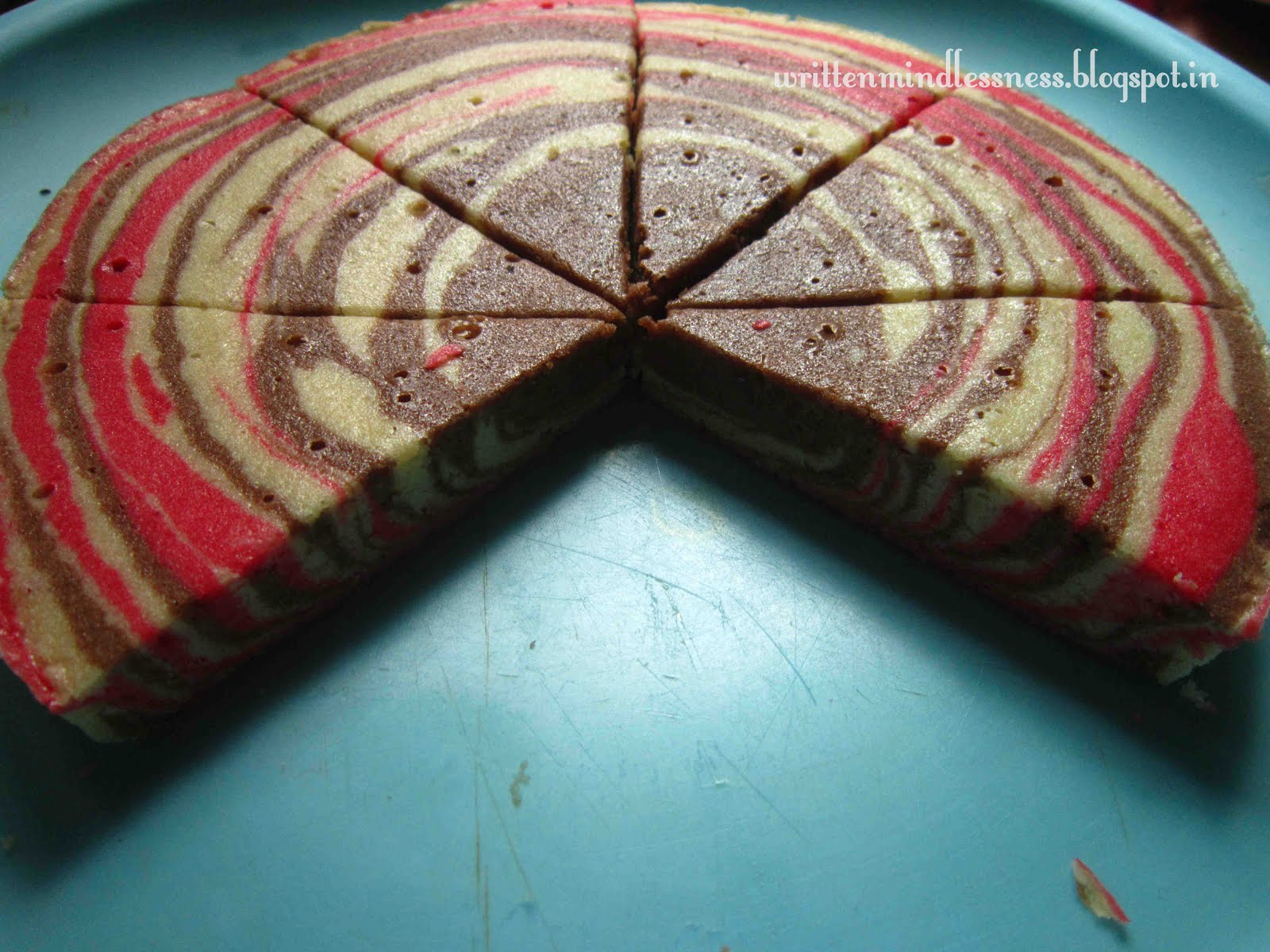
Recipe: Rainbow Marble Cake


I was in love with the colourful sandwich cake they served in cafes but then I am too lazy and miser to go out and spend. So here's what I do. Get my people shop for the ingredients and then make my cool snacks myself. :P You too can try out.


Ingredients

·         Flour (300g)

·         Sugar (200g)

·         Butter (100g)

·         3-4 eggs
Milk (2-3 tablespoon)

·         Baking powder1/2 teaspoon

·         Cocoa powder (two tablespoon)

·         Cadbury Diary Milk Chocolate (8 cube)

 Vanilla essence (a few drops) 
Strawberry essence ( few drops)
Edible pink food colour (1-2 drops)


Procedure:
1. Take sugar in a bowl and add melted butter to it. Mix it well until the sugar blends with the butter and becomes fine.
Tip: Use grounded/powdered sugar to save time. 
2. Now add the eggs and beat it well.

Caution: Do not add eggs to hot butter unless you want sweet scrambled eggs.
3. Add flour little by little and keep mixing it.
4. Add half teaspoon of baking powder.
5. Keep beating the batter until a thick, smooth consistency is achieved.
6. Now take out the mixture in equal quantity in three separate blows and keep aside.
7. Break the chocolate cubes in small pieces and using the double boiler method melt it smooth. Add little milk to make it quick.

8. Now add this melted chocolate to one bowl of the batter you have kept aside. Mix it well and add cocoa powder. Beat well. Now in another batter add strawberry essence and edible pink colour. Mix it well. Add vanilla essence to the white batter. Now you have three batters- one brown, one pink and the other white. 

9. Grease the baking mould with oil and sprinkle some flour. 

10. Now comes the main part of bringing the texture of the rainbow cake. Take a tablespoon for each batter (Brown, pink and white). Drop one tablespoon of white batter in the center of the mould. Then exactly on top of it drop the pink batter followed by the brown. Again drop the white batter then the pink and brown. Repeat this until you have put the batters one after another in the baking mould. The mixture will keep spreading on its own as you keeping dropping the batters in the center.

Tip: Pre-heat oven to 180 degrees while you are pouring the batter.


11. Put the filled mould in the oven and bake for 40 minutes.
12. After 40 minutes check if the cake is ready or not by pricking in a fork. If the fork comes out clean, the cake is ready.
13. Turn off the oven and keep the cake inside for some time to allow it to cool.
14. When it cools down, take it out from the mould and serve with your favourite strawberry jam or chocolate topping.


You can make rainbow muffins by changing your mould. Use cupcake moulds instead. Tada! There are your fluffy rainbow muffins!


Do share your views if you have tried the recipe. :)

Regards,
Jaismita Alexander.

Monday, 30 May 2016

Marble Cake: Easy 14 Steps


Though my blog clearly shouts out the name 'WRITTEN MINDLESSNESS' but this post is quite mindful. After posting a few pictures on Facebook of a Marble Cake I baked today, many have asked for the recipe of it. So here it is, for everyone's convenience I am posting the most easiest recipe of the delicious dessert.


Ingredients
·         Flour (300g)

·         Sugar (200g)

·         Butter (100g)

·         3-4 eggs
Milk (2-3 tablespoon)

·         Baking powder1/2 teaspoon

·         Cocoa powder (two tablespoon)

·         Cadbury Diary Milk Chocolate (8 cube)

 Vanilla essence (a few drops)


Procedure:
1. Take sugar in a bowl and add melted butter to it. Mix it well until the sugar blends with the butter and becomes fine.

Tip: Use grounded/powdered sugar to save time.

2. Now add the eggs and beat it well.

Caution: Do not add eggs to hot butter unless you want sweet scrambled eggs.

3. Add flour little by little and keep mixing it.

4. Add half teaspoon of baking powder and vanilla essence. 

5. Keep beating the batter until a thick, smooth consistency is achieved. 

6. Now in a separate bowl take out half of the mixture and keep aside.

7. Break the chocolate cubes in small pieces and using the double boiler method melt it smooth. Add little milk to make it quick.

8. Now add this melted chocolate to the half of the batter you have kept aside. Mix it well and add cocoa powder. Beat well. Now you have two batter- one brown and the other white. 

9. Grease the baking mould with oil and sprinkle some flour. 

10. Now comes the main part of bringing the texture of the marble cake. Take a tablespoon for each batter (Brown and white). Drop one tablespoon of white batter in the center of the mould. Then exactly on top of it drop the brown batter. Again drop the white batter. Repeat this until you have put the batters one after another in the baking mould.

Your mould should look like this now.


Tip: Pre-heat oven to 180 degrees while you are pouring the batter.

11. Put the filled mould in the oven and bake for 40 minutes.


12. After 40 minutes check if the cake is ready or not by pricking in a fork. If the fork comes out clean, the cake is ready.

13. Turn off the oven and keep the cake inside for some time to allow it to cool.

14. When it cools down, take it out from the mould and serve with your favourite chocolate topping.


Do share your views if you have tried the recipe. :)

Regards,
Jaismita Alexander.