“Shongshare jara sudhu dile, kintu
pele na kichui jara durbol, utpirito, manush hoye o manush jader chokher joler
kokhon o hishab nilen na, nirupay dukkho moy jibon e jara konodin bhebei pelen
na. Shomostho thekei o keno tader kichu tei odhikar nei, tader bedonai dilo.
Amar mukh khule tarai pathalo manusher kache manusher nalish janate. “
― Sharat Chandra Chattopadhyay
 |
| River Rupnarayan |
With this quote written on the left side of the gate
still stands proud the beautiful house of the great Bengali novelist Sarat
Chandra Chattopadhyay known as Sarat
Chandra Kuthi. Sarat Kuthi is located in Samta in Deulti, Howrah about 50
km drive from Kolkata. Deulti is a small village located towards the west part
of Bagnan. One can visit the land of Sarat Chandra in one day. It takes only
one and a half hour to reach from Kolkata. The bank of River Rupnarayan is a
famous picnic spot.
About the Author
Sarat Chandra Chattopadhyay was born on 15th
September, 1876 in Debanandapur, Hoogly. He started his career as an Author
with the story ‘Mandir’. He received
the Kuntolin award for his first
masterpiece- Mandir. He also gained popularity with his pseudonym
Anila Devi, the real name of his elder sister. He Sarat Chandra Chattopadhyay’s
first wife was Shanti Devi who died in Burma due to Plague. His boy child from
the first wife also died from the same sickness.
After the death of his first
wife, he got married to Hironmoyee Devi who was previously known as
Mokkhoda. He
was also a homeopath and was therefore known as Dr. Sarat Chandra
Chattopadhyay. The author composed popular novels like Palli Samajh, Parineeti, Mahesh, Shubodha, Srikanto, Devdas etc.
Sarat Chandra died on 16th January, 1938 at the age of 61.
About the house
Sarat Smriti Mandir is written in
Bengali on the right side of the gate and followed by this there is a quote
from the popular novel Mahesh written below. The house is two storied and has
been built in Burmese-style. Sarat Kuthi
was built on the bank of River Rupnarayan, which still flows by but the river
has moved far away in the due course of time due to excessive silting. It is
said that the author has penned down some of his famous novels and stories in
the study of this house. It is known that the author spent the last twelve
years of his life in this house. The study and other rooms along with its
furniture are still preserved with great care for more than a century now. This
house was once the home of Sarat Chandra’s brother Swami Vivekananda also.
There are many things of interest still preserved in the house which, according
to the sources, draws the tourist from abroad. The building is now a museum containing
various articles used by the author in his daily life. Let’s together explore
the abode of the great Bengali Novelist.

The Garden
As one enters the compound of Sarat Chandra Kuthi, one can see the huge house standing in front
among the beautiful garden. Towards the left of the garden a statue of the author stands. One can also spot the Guava tree mention in the novel Palli Samajh. The
samadhis of Sarat Chandra
Chattopadhyay, his wife Hironmoyee Devi and brother Bedananda lie in the end of the garden. The puja mandap is also in the same garden.
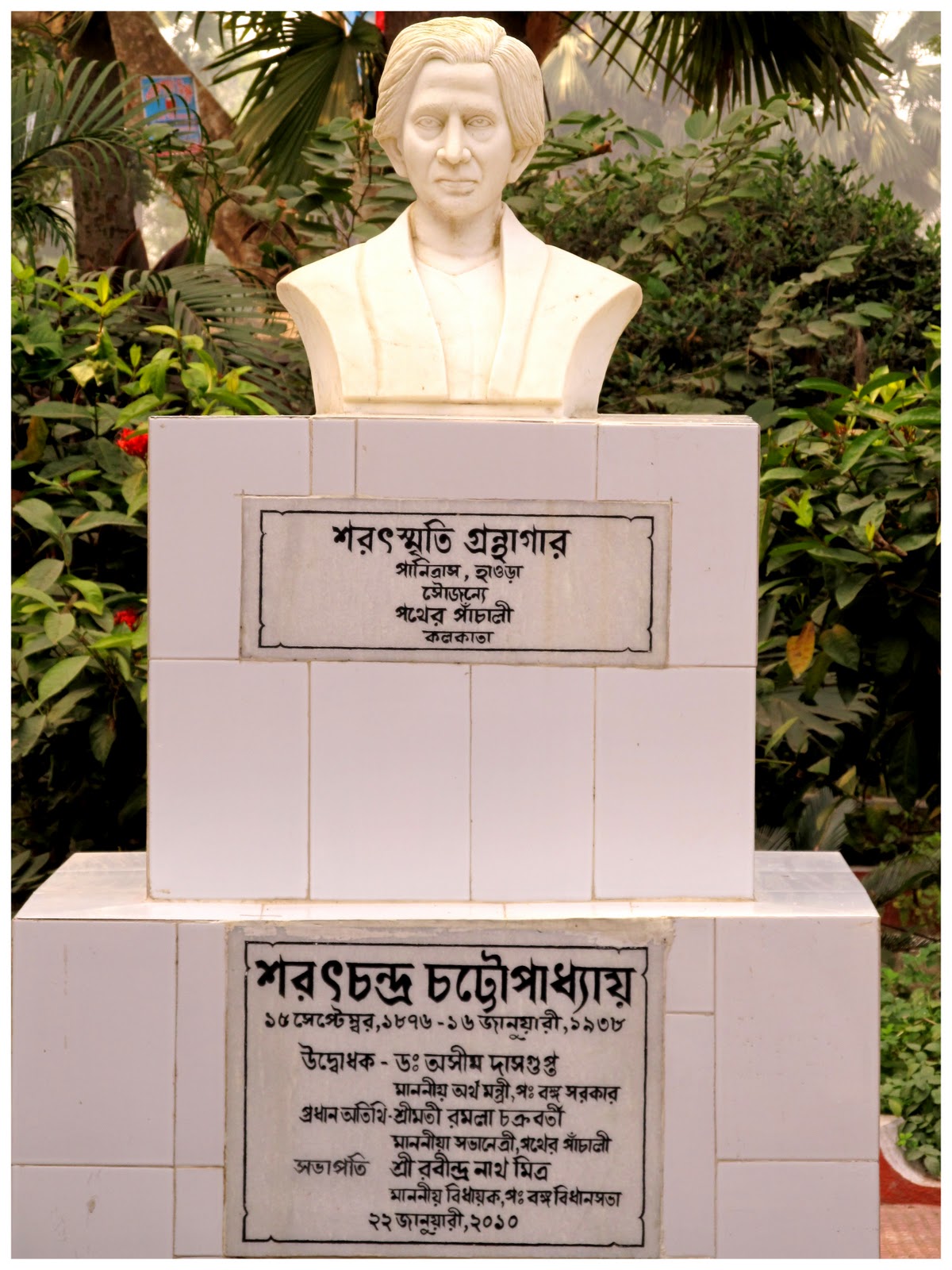
The Bust
The marble bust of
the author is situated at the left side of the garden, among some beautiful
plantations. The statue was erected by Dr. Ashim Dasgupta, former Finance
Minister of West Bengal in 2010.
The Guava Tree
The author
during his stay in this compound planted various trees in the garden. Among
them were some bamboo trees and Galoncho with
guava trees. One guava tree has grown up exactly in front of the main house.
According to the sources, it is said that this tree is more than 90 years old.
The same tree is said to be mentioned in the author’s masterpiece Ramer Sumati. The trees are still an
attraction to the tourists.
The Samadhis
In the memorial of the great novelist, Sarat Chandra and his beloved wife and brother three stones have been laid in the compound of the Sarat Chandra Kuthi. Initially, the three samadhis used to be on the road outside the compound. Later it was brought under the same compound by extending the boundary walls of the garden.
 |
| Samadhi of Sarat Chandra's second wife Hironmoyee (left); The samadhi of brother Debananda (left) & Sarat Chandra Bose (right) |
The Ground Floor
The ground
floor has a front veranda with three rooms. The first one is the study of Sarat
Chandra. Beside it is a bedroom and then is the homeopathy chamber. After the
chamber, there is a small corridor leading to the stairwell of the first floor.
On the front right-side of the house, there is a huge cage. It is said that the
author loved animals so he kept peacocks. The kitchen and dining hall is also
down but is under construction.
The Study Room
 |
| 1- Bookshelf; 2- Arm chair; 3- Chappal worn by Sarat Chandra, 4- Study table |
The study
room is quite small. It has a writing desk, an arm chair and a bookshelf. Some
shelves are made on the walls. They still have some books and old pictures. In
the same room one can see Sarat Chandra’s walking stick & chappals
preserved in a box. The arm chair has his framed photo and a picture of his
dead body adorned with flowers and garlands. The guide will narrate to you
stories of the past. According to him, Sarat Chandra used the room as the study
because the huge window used to give him the view of the river. The river was
very near to the house that time. The author composed great stories like Abhagir Swargo, Bamuner Meye, Mahesh, Ramer Shumoti, Palli Shomaj, Srikanta
fourth part and last he wrote Bipradas
in this room.
The Bedroom
Just next to
the study room is a bedroom. It is quite spacious. The bed is kept on the left
side of the room. A white bedcover is laid white two pillows. There is a huge
cupboard with some medical books in it. There is a star shaped hanger on the
wall. The same room has a door that leads to the next room. At the end of the
room, an old radio system and a hookah is kept. The walls of the room have some
old framed pictures. There is also a made in Japan wall clock that draws
attention of the visitors. The care taker says that he, for the past 40 years
did not allow it to stop. There is a key that needs to be turned every week for
it to keep working.
 |
| 1- Star shaped Hanger, 2- Wall clock, 3- Old radio system and Hookah, 4- Caretaker of the house |
The Homeopathy Chamber
The bedroom connects to the homeopathy chamber. The room is quite big and has a big arm chair at the side of the door that connects to the bedroom. There is a cupboard that has glass frames on door. One can spot some old glass vials still kept intact inside. Just opposite to the cupboard there is a single bed kept at the side with a chair at its head. Both are kept near a huge door that opens to the front entrance. According to the guide, Dr. Sarat Chandra used to visit patients here and treated them for free. At the end of the room there is a small altar. The altar has two stone idols of Lord Krishna and Radha. According to the sources they were gifted by C.R. Das to the author. A small red bulb is fitted in, that is kept on 24 hours. There are two different kinds of Charkkha miniatures kept for show. The guide says that they were gifted by Gandhiji.
 |
| 1- Old homeopathy vials, 2- Patients' bed in the chamber, 3- Charkha said to be gifted by Gandhiji, 4- Statue of Radha Krishna |
The First Floor
The first
floor is under construction. It has two rooms. The guide says that Sarat
Chandra used to stay down in the daytime and only came up in the night to
sleep. The bedrooms have beds, chairs, some side tables and cupboards. There is
a small open latrine is the corridor. The corridor is spacious and is in good
condition. Though a side is being renovated and access to the part is not
allowed for the timing. There are a few
cages kept upstairs that had rabbits in them. A few pigeons were also kept. The
cages are empty now.
The Courtyard
The
courtyard is big and it has a small storehouse for grains. There is a rusted
hand pump. The courtyard is half cemented yet well maintained.
The Pond
There is a
pond just opposite to the house. The guide says that the pond had two pet
fishes in them. One Rohu and another was Katla. Sarat Chandra’s wife had named
them Kartik and Ganesh. This pond and
the fishes were mentioned in the author’s masterpiece Ramer Sumati.
The house
and its compound are well-maintained by the care-taker. He has been employed by
the author’s Grandson. The best time to visit Deulti, Sarat Chandra Kuthi is
during the winter and spring. National Holidays should be avoided. The heritage
house is open all throughout the year. It is suggested that one must visit
Deulti during the Sarat fair that is held during September-October.
Good to Know
- Samta, Deulti is approximately 50 km from
Kolkata. It takes one and a half hour to reach.
- There are a few temples that can be visited too.
- The Sarat Mela is very famous. Every year many
food stalls are set up in this fair.
- Nirala Resorts & SonarBangla are two very
good hotels.
- There are quite a few eating outlets, dhabas and
restaurants on the Highway.
Jaismita Alexander
The same was published by TTIS- The Telegraph In Schools